Articles
What Is a Pip in Forex? Lots, Ticks & Sizes Explained

I remember my first live trade. Clicked buy on GBP/USD, watched it move 23 pips in my favor, and thought I was about to retire early. Then I checked my actual profit: $2.30. Turns out I’d traded a micro lot without realizing it. I had no idea what I was doing with position sizes, and honestly, I barely understood what is a pip in forex beyond “the number that moves on the chart.”
Sound familiar?
These basics — pips, points, lots, contract sizes — aren’t exciting. Nobody gets into trading because they’re pumped about learning unit measurements. But here’s the thing: if you don’t understand these fundamentals, you can’t size positions properly. You can’t calculate risk. You can’t even read your P&L correctly.
At CypherTrade, we’ve seen traders blow accounts not because their strategy was bad, but because they accidentally traded 10x their intended size. Or they set a “50 pip stop loss” without knowing that meant $500 on a standard lot. These aren’t strategy problems. They’re vocabulary problems.
Let’s fix that.
What Is a Pip in Forex Trading?
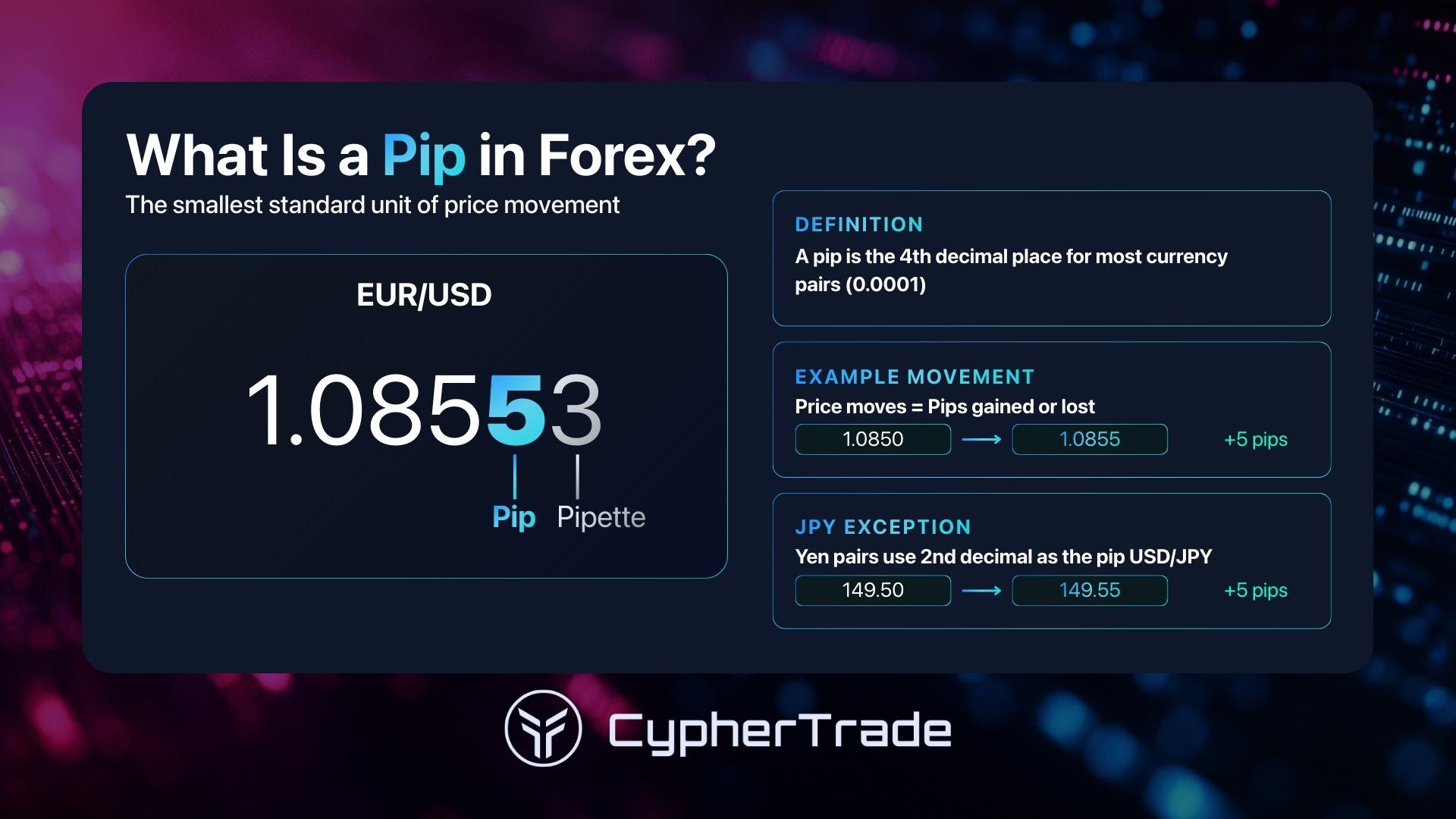
A pip is the smallest standard price movement in a currency pair. For most pairs, that’s the fourth decimal place.
EUR/USD moves from 1.0850 to 1.0851? That’s one pip.
GBP/USD drops from 1.2643 to 1.2640? That’s three pips down.
The word “pip” stands for “percentage in point” or “price interest point” — depends who you ask. Doesn’t really matter. What matters is understanding that this tiny unit is how forex traders measure everything: profits, losses, spreads, and stop distances.
The Japanese Yen Exception
Yen pairs work differently. Because the yen is worth so much less per unit than the dollar or euro, JPY pairs only quote to two decimal places.
USD/JPY at 149.50 moving to 149.53? That’s three pips. The second decimal is the pip, not the fourth.
This trips up beginners constantly. They’ll see USD/JPY move from 149.00 to 150.00 and think “that’s only one pip.” No — that’s 100 pips. Big difference when you’re calculating risk.
Pipettes: The Fifth Decimal Place
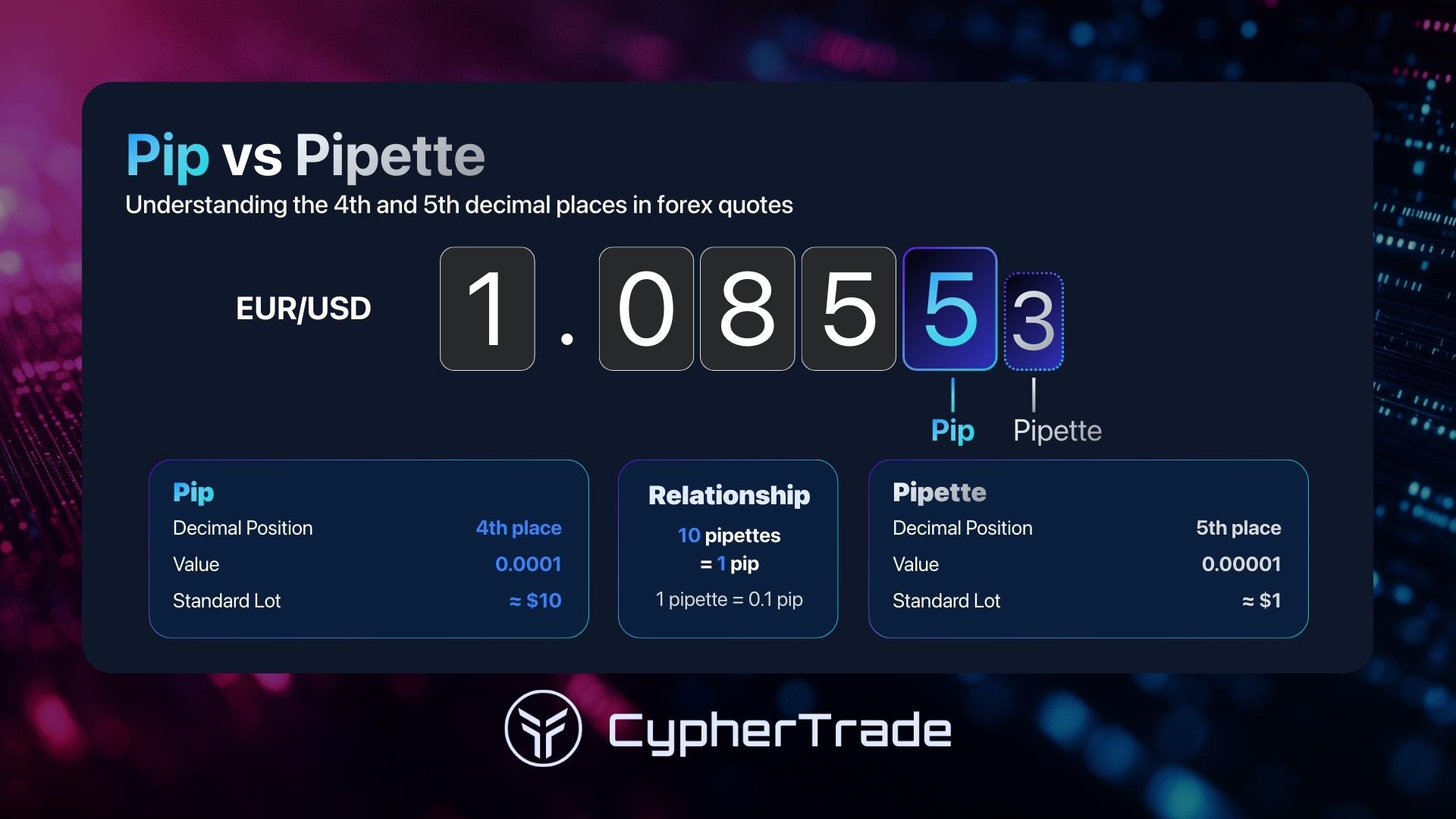
Most brokers now show a fifth decimal place (or third for yen pairs). That extra digit is called a pipette or fractional pip — it’s 1/10th of a pip.
So EUR/USD at 1.08503 means the price is 1.0850 and three-tenths of a pip. Some traders ignore pipettes entirely. Others use them for tighter entries. Either approach works, just know what you’re looking at.
Understanding the Bid-Ask Spread in Forex
Before we get to lot sizes, you need to understand the bid-ask spread forex brokers show you. Every currency pair has two prices:
- Bid: The price you sell at
- Ask: The price you buy at
The ask is always slightly higher than the bid. That gap? That’s the spread, measured in pips.
If EUR/USD shows 1.0850/1.0852, the spread is 2 pips. You buy at 1.0852, but the market would need to move up 2 pips just for you to break even if you sold immediately.
Why Spread Matters for Your Trading
This is why spread matters so much for scalpers. A 2-pip spread on a trade targeting 10 pips means 20% of your potential profit is gone before price even moves. During volatile news or thin liquidity (Asian session on EUR/USD, for example), spreads can balloon to 5, 8, even 15 pips on major pairs.
We covered session timing in our forex market hours guide — spreads are one of the main reasons timing matters.
For swing traders with 100+ pip targets, a 2-pip spread is basically irrelevant. But for anyone trading shorter timeframes, spread costs add up fast. Factor them into your strategy from day one.
Forex Lot Sizes Explained: Standard, Mini, Micro, and Nano
Here’s where things get practical. A “lot” is the standardized unit size for forex trades. When someone says they “bought one lot of EUR/USD,” they’re talking about a specific forex contract size.
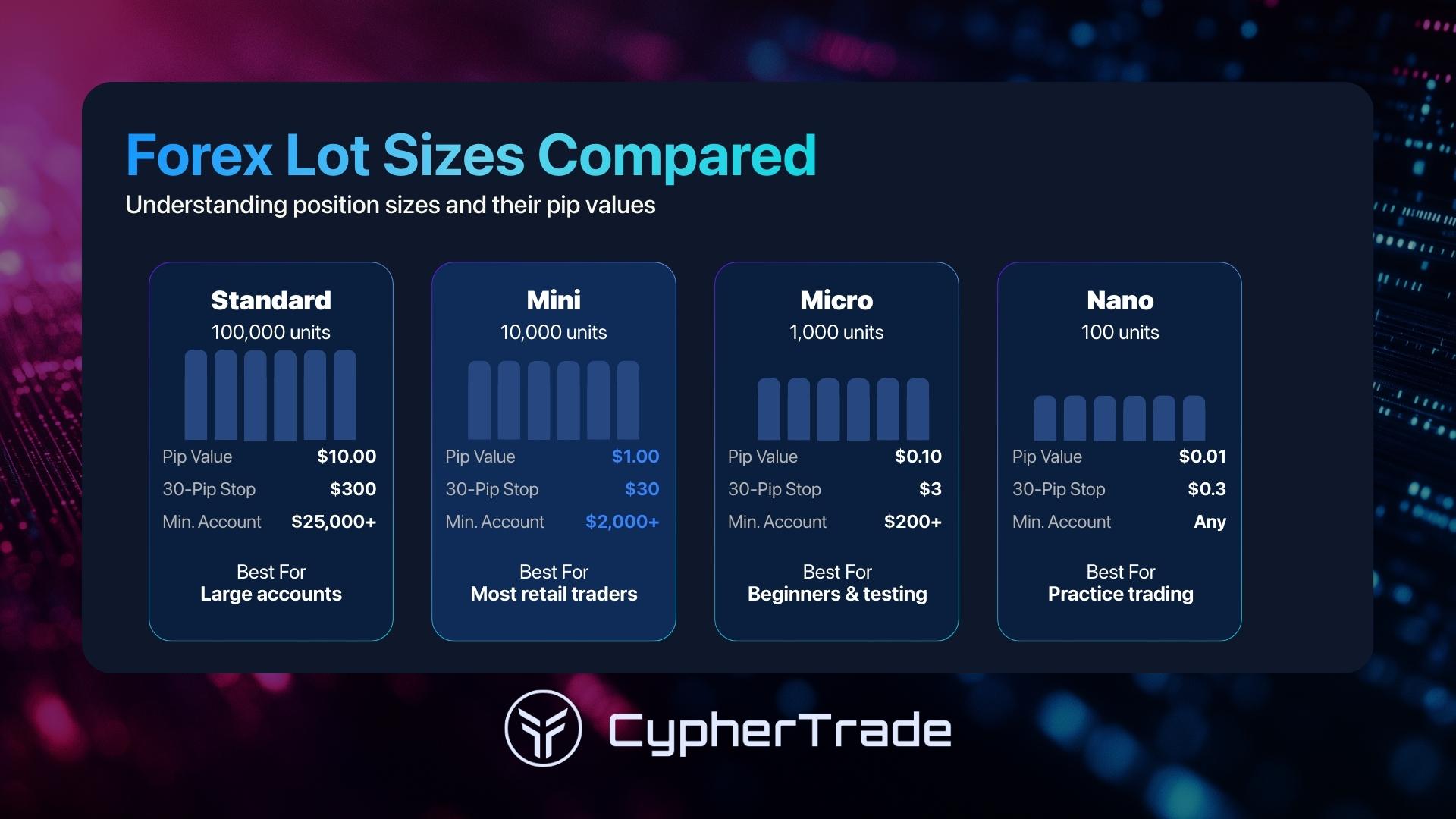
Standard Lot (100,000 Units)
One standard lot = 100,000 units of the base currency.
If you buy 1 lot of EUR/USD, you’re controlling €100,000 worth of euros. At typical leverage (let’s say 30:1), you’d need around $3,333 in margin to open that position.
On a standard lot, each pip movement equals roughly $10 for USD-quoted pairs. EUR/USD moves 50 pips in your favor? That’s $500. Moves 50 pips against you? You’ve lost $500.
This is why standard lots aren’t for small accounts. A normal 30-pip stop loss costs $300. If your account is $5,000, that’s 6% risk on a single trade — way too high for sustainable trading.
Mini Lot (10,000 Units)
One mini lot = 10,000 units of the base currency.
Everything scales down by 10x. Each pip is worth roughly $1 on USD pairs. A 30-pip stop loss costs $30.
Mini lots are where most retail traders operate. They allow meaningful position sizes without requiring huge capital, and the math is easy: 1 pip = $1. When comparing standard lot vs mini lot, the mini is simply one-tenth the size with one-tenth the pip value.
Micro Lot (1,000 Units)
One micro lot = 1,000 units of the base currency.
Pip value: roughly $0.10 on USD pairs. A 30-pip stop equals $3.
Micro lots are ideal for beginners or anyone testing strategies with real money but minimal risk. They’re also useful for precise position sizing — if your risk calculation says you should trade 2.7 mini lots, you can trade 27 micro lots instead and nail the exact size.
Nano Lot (100 Units)
Some brokers offer nano lots (100 units) with pip values around $0.01. Less common, but useful for absolute beginners who want live market experience with essentially zero financial risk.
Forex Lot Sizes Quick Reference
| Lot Type | Units | Pip Value (USD pairs) | 30-Pip Stop Cost | Best For |
| Standard | 100,000 | ~$10 | ~$300 | Large accounts ($25k+) |
| Mini | 10,000 | ~$1 | ~$30 | Most retail traders |
| Micro | 1,000 | ~$0.10 | ~$3 | Beginners, strategy testing |
| Nano | 100 | ~$0.01 | ~$0.30 | Practice with live markets |
Pip Value Calculation: The Math Behind Your P&L
“Roughly $10 per pip” works for quick mental math, but the actual pip value calculation depends on the pair you’re trading and your account currency.
Calculating Pip Value for USD-Quoted Pairs
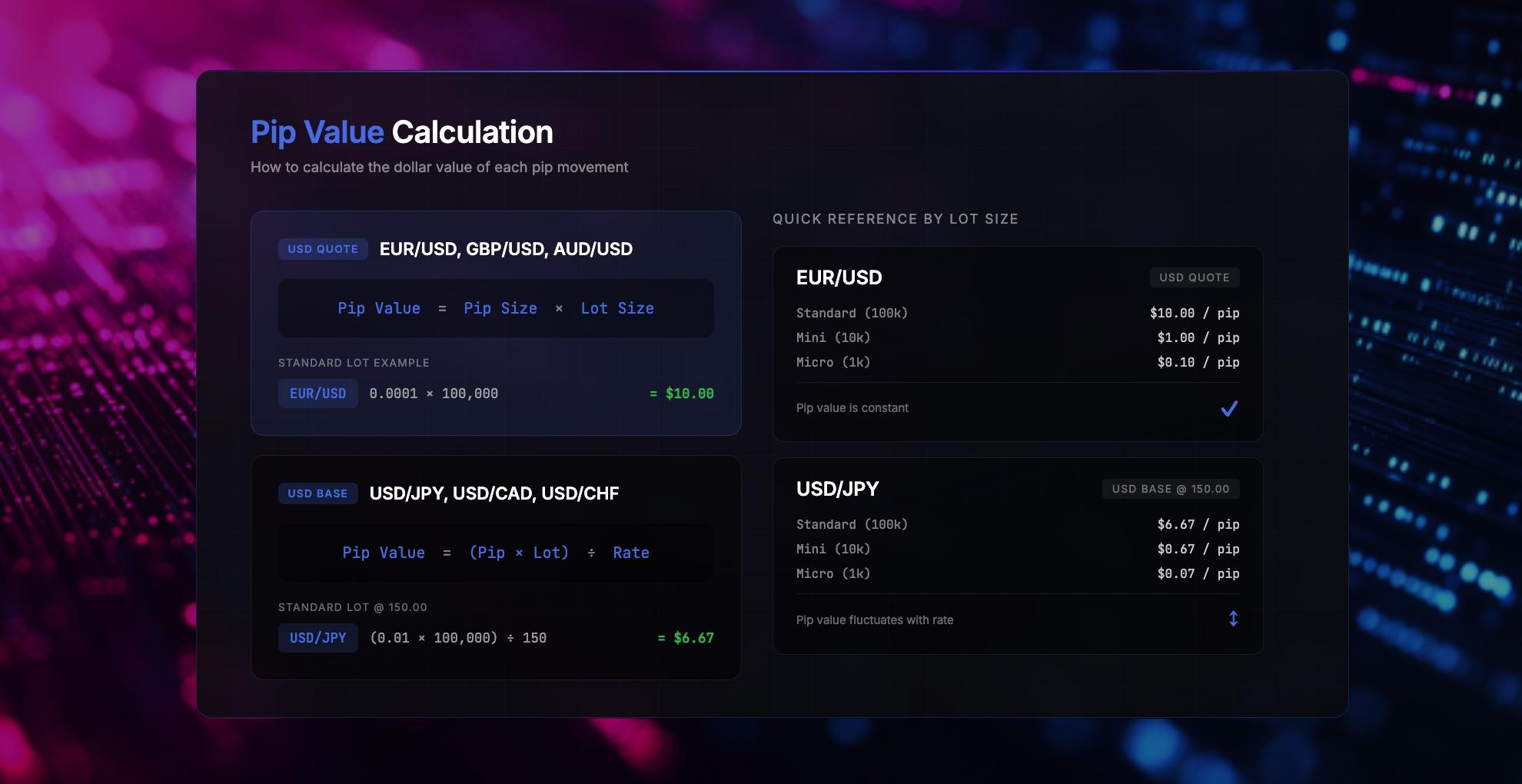
When USD is the quote currency (second in the pair) — like EUR/USD, GBP/USD, or AUD/USD — the math is straightforward:
Pip Value = Pip Size × Lot Size
For EUR/USD with a standard lot:
- Pip size = 0.0001
- Lot size = 100,000
- Pip value = 0.0001 × 100,000 = $10
Easy. The pip value stays constant regardless of the exchange rate because your profit/loss is already in USD.
Calculating Pip Value for USD-Based Pairs
When USD is the base currency (first in the pair) — like USD/JPY, USD/CAD, or USD/CHF — you need to convert:
Pip Value = (Pip Size × Lot Size) ÷ Exchange Rate
For USD/JPY at 150.00 with a standard lot:
- Pip size = 0.01 (remember, yen pairs use two decimals)
- Lot size = 100,000
- Pip value = (0.01 × 100,000) ÷ 150.00 = $6.67
The pip value fluctuates as the exchange rate changes. This is why USD/JPY pip values feel inconsistent — because they literally are.
Cross Pairs Get Complicated
Cross pairs (EUR/GBP, GBP/JPY, AUD/NZD, etc.) get messier because neither currency is USD. You calculate pip value in the quote currency, then convert to USD at current rates.
Honestly? For most traders, just use a pip calculator. Doing this math manually for every trade is tedious and error-prone. The important thing is understanding the concept so you can sanity-check your position sizes.
Forex Contract Size and Leverage: What You’re Actually Controlling
The forex contract size refers to the total value of your position — not your margin, but the full notional amount you’re controlling.
This matters because leverage amplifies everything.
Let’s say you buy 1 standard lot of EUR/USD at 1.0850 with 30:1 leverage:
- Contract size: €100,000 × 1.0850 = $108,500
- Required margin: $108,500 ÷ 30 = $3,617
You’re controlling over $100,000 with less than $4,000. That’s powerful — and dangerous.
A 1% move against you on that position means a $1,085 loss. If your account is $10,000, that’s nearly 11% gone from a move that barely registers on a daily chart.
The Leverage Trap
Most beginners don’t think in terms of contract size. They see “1 lot” and don’t realize they’re controlling six figures. Then they’re shocked when a 50-pip move — completely normal intraday volatility — wipes out a significant chunk of their account.
This is why understanding leverage and margin is non-negotiable before trading live. The numbers can spiral fast if you’re not paying attention.
At CypherTrade, we recommend beginners start with micro lots regardless of account size. Learn the mechanics with minimal risk, then scale up once you’ve proven you can manage positions properly.
Points vs. Pips: Clearing Up the Confusion
You’ll hear “points” thrown around in trading, and it means different things depending on context.
In forex: A point usually equals a pipette (the fifth decimal). So “10 points” = 1 pip. Some platforms display price changes in points rather than pips, which confuses beginners who think they made 50 pips when they actually made 5.
In indices/stocks: A point is the minimum price increment for that instrument. One point on the S&P 500 is $1. One point on the Dow is $1. These don’t translate to forex pips at all.
In futures: Depends entirely on the contract. E-mini S&P futures move in 0.25-point increments worth $12.50 each. Completely different system.
How to Avoid Points/Pips Confusion
Check your platform settings. Most trading software lets you choose between displaying price changes in pips or points. MetaTrader 4/5, for instance, often defaults to points. If you’re seeing numbers that seem 10x larger than expected, that’s probably why.
The takeaway: always verify what “points” means on your specific platform and instrument. Don’t assume.
Position Sizing: Putting Pip Values and Lot Sizes Together
Alright, let’s use this knowledge for something practical — figuring out how many lots to trade based on your risk tolerance.
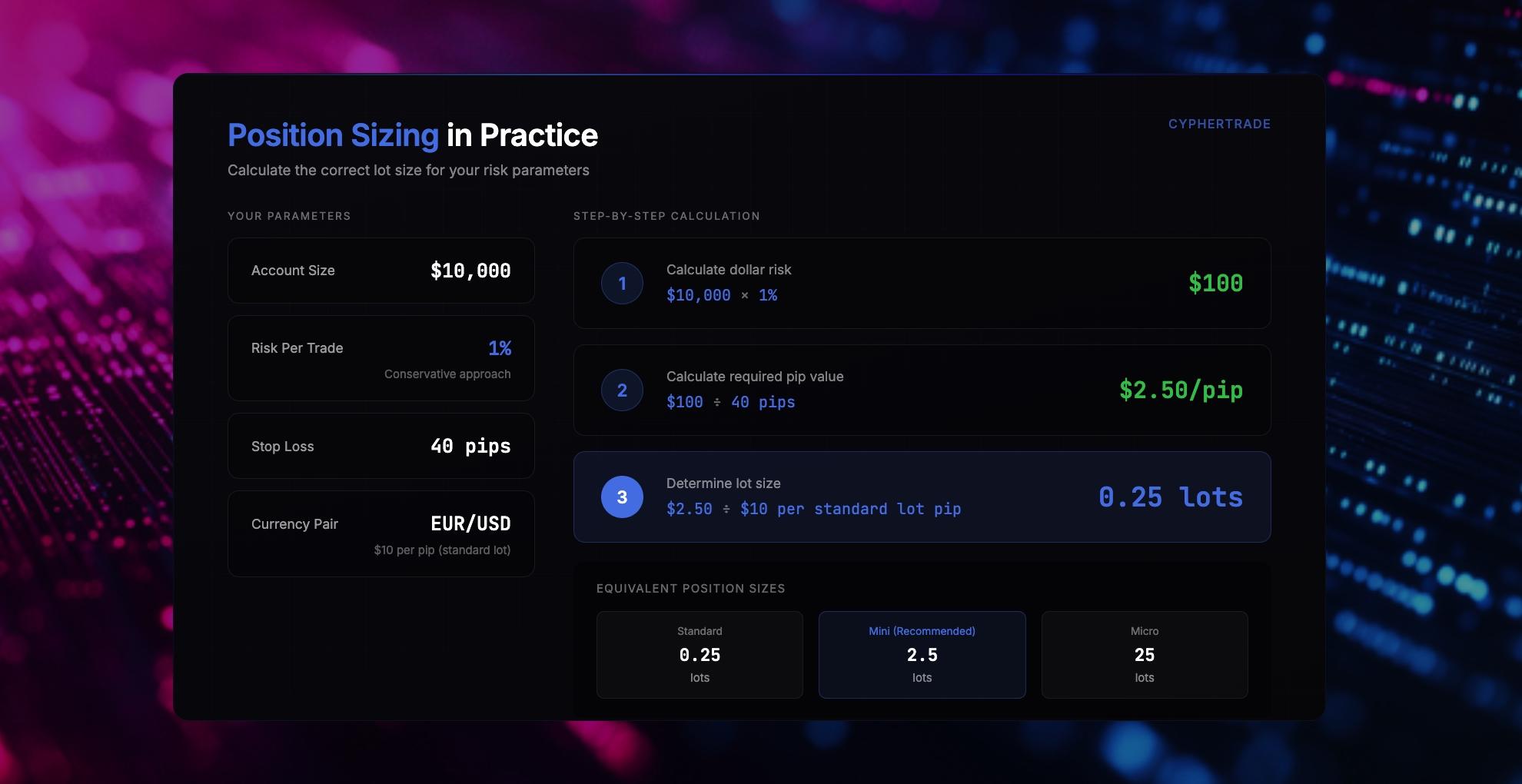
Say you want to risk 1% of a $10,000 account on a EUR/USD trade with a 40-pip stop loss.
Step 1: Calculate dollar risk
- $10,000 × 1% = $100 maximum loss
Step 2: Calculate required pip value
- $100 ÷ 40 pips = $2.50 per pip
Step 3: Determine lot size
- Standard lot = $10/pip → too big
- Mini lot = $1/pip → $2.50 would require 2.5 mini lots
- In micro lots: 25 micro lots (or 0.25 standard lots)
Result: Trade 0.25 standard lots, 2.5 mini lots, or 25 micro lots. Your 40-pip stop loss will cost exactly $100 if triggered — 1% of your account, as planned.
Do this calculation before every single trade. At CypherTrade, we recommend using a position size calculator until the math becomes automatic. Most traders never bother with proper position sizing, and it shows in their inconsistent results.
Common Mistakes When Learning Pips and Lot Sizes
After watching hundreds of new traders, these are the errors we see repeatedly:
Trading default lot sizes. Most platforms default to 1.00 lots. New traders click buy without changing it and suddenly they’re in a $100,000 position. Always double-check your size before executing.
Forgetting spread in risk calculations. If your stop is 30 pips and spread is 2 pips, your actual risk is 32 pips. Matters less on swing trades, but scalpers need to account for it every time.
Confusing points with pips. Already covered this, but it’s worth repeating. A “50 point” move might only be 5 pips depending on your platform settings.
Using the same lot size regardless of stop distance. Your position size should adjust based on stop loss width. A 20-pip stop needs a larger position than a 50-pip stop to risk the same dollar amount. This is position sizing 101, but most beginners skip it entirely.
Ignoring pip value changes on non-USD pairs. If you’re trading USD/JPY and the exchange rate moves significantly over time, your pip value changes too. Recalculate periodically, especially for longer-term positions.
Overleveraging because “it’s just micro lots.” Ten micro lots is still a mini lot. Thirty micro lots is three mini lots. Small units add up. Don’t let the word “micro” trick you into oversizing.
Practice These Concepts Before Trading Live
Here’s my honest advice: don’t trade real money until pip calculations and lot sizing are automatic.
Open a demo account. Place trades with different lot sizes. Watch how pip movements translate to dollar gains and losses. Practice calculating position sizes manually, then verify with a calculator.
Suggested practice routine:
- Calculate position size for 5 different scenarios (varying account sizes, stop distances, risk percentages)
- Place demo trades at each lot size and observe P&L changes per pip
- Switch between USD-quoted and JPY pairs to see pip value differences firsthand
- Intentionally trade during high-spread periods (news, Asian session for EUR/USD) to feel the impact
Give yourself 1-2 weeks of deliberate practice with these concepts. It sounds basic, but I’ve seen traders with months of screen time who still can’t properly size a position. They skipped the fundamentals and pay for it over and over.
The goal isn’t to memorize formulas. It’s to develop an intuitive feel for what your positions actually mean in dollar terms.
Wrapping Up: Why This Foundation Matters
Understanding what is a pip in forex, how lot sizes work, and how to calculate position size isn’t glamorous. There’s no edge here — just essential vocabulary every trader needs.
But without this foundation, nothing else works. You can’t manage risk if you don’t know your pip value, you can’t size positions correctly if you don’t understand the difference between standard lot vs mini lot. You can’t even read your P&L accurately if you’re confused about points versus pips.
Take the time to learn these basics properly. Practice the calculations. Use the tools available — pip calculators, position sizers, demo accounts. Then move on to strategy development, knowing your foundational knowledge is solid.
And remember: position sizing is your primary risk control. Get this right, and you’ve already avoided the most common way traders blow accounts. Get it wrong, and no strategy in the world will save you.
Recent Articles

Forex Market Hours: Best Sessions to Trade
22.01.26
I’m going to be honest with you — I wasted my first six months of trading because nobody explained forex market hours properly. I’d spot what looked like a textbook setup on EUR/USD, pull the trigger, and then… nothing. Price would just sit there. Sideways. For hours. Eventually my stop would get clipped by some […]

How Trading Markets Work? Forex, Stocks & Crypto Guide
07.01.26
Introduction You’re reading financial news and see “gold hits new highs” or “US indices close in the red.” Cool. But what does that actually mean? More importantly — how do trading markets work, and why should you care? If you’re honest, probably not much on both counts. Most people nod along when traders talk about […]